
Her.AI - Funny Chat Friend
MohamedGMohieEntertainment
4.71.19K Reviews
- Version
- 2.3.5
- Installs
- 500.00K
- Age Rating
- Mature 17+
Screenshots


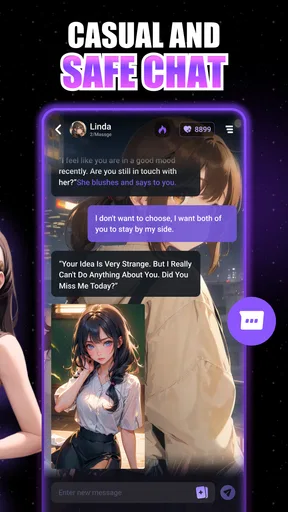




Our Review of Her.AI - Funny Chat Friend
 Analysis by Appyee
Her.AI - Funny Chat Friend is the kind of entertainment app I would open when I want a quick conversation rather than another video, game, or social feed. Its central idea is simple: chat with a virtual AI companion and see where the exchange goes. In my experience, that unpredictability is the main appeal. A short prompt can turn into playful banter, an odd question, or a longer conversation that feels more engaging than passively scrolling.
That also makes it a very particular type of app. I would not treat it as a replacement for a real friend, a private journal, or a serious advice service. I see it more as an interactive character experience for adults who enjoy experimenting with conversation. The app is listed as free, with optional purchases ranging from $3.49 to $54.99 per item, so trying the basic experience does not require an upfront payment, but anyone who becomes a frequent user should pay attention to where optional spending enters the experience.
What using Her.AI feels like in everyday life
The best way to understand this app is to imagine a small break in the day. I might be waiting for a bus, winding down after work, or simply looking for something more active than watching short clips. Instead of choosing a fixed episode or puzzle, I can start a conversation and guide it with my own wording. That gives the experience a personal rhythm: I decide whether the exchange stays silly, becomes imaginative, or ends after a few messages.
Its entertainment value comes from participation. A conventional streaming app gives me a finished piece of content, while Her.AI asks me to contribute the next line. That difference matters. If I am tired and want effortless viewing, a video app is usually better. If I want to test an idea, make up a scenario, or enjoy a conversational surprise, this app has more room for improvisation.
I found that the quality of the experience depends heavily on how clearly I phrase a prompt. Short, vague messages can lead to a flat exchange, while a specific setup gives the conversation more direction. For example, I might ask for a playful debate about an everyday choice, request a fictional situation, or set a light conversational challenge. The useful trick is to treat each message as steering rather than merely asking a question.
That makes Her.AI more interesting for people who like role-play and conversational experiments than for users who expect a clearly defined game loop. There are no points, levels, or conventional missions to motivate me here. The reward is the conversation itself, and that can feel fresh one day and repetitive the next. I would recommend approaching it as a flexible pastime, not as a structured game with a predictable sense of progress.
The app comes from MohamedGMohie and sits in the entertainment category. Its overall reception is strong, with a 4.7 average from around 16 thousand ratings and roughly 1.2 thousand written reviews. It has passed half a million installs, which suggests that the idea has reached a substantial audience without changing what it is: a chat-focused experience rather than a broad social network.
Why the mature rating changes the way I would use it
Her.AI carries a Mature 17+ content rating. I would take that seriously before installing it, especially on a shared device or a family account. The rating signals that this is not an app I would hand to a younger teenager simply because the interface looks like a normal chat window. Adults should also remember that conversational systems can move in unexpected directions depending on the prompt and the context of the exchange.
For me, the mature classification creates a practical boundary: I would keep conversations light unless I had a clear reason to explore more sensitive themes, and I would avoid treating the chat as a place for personal disclosures. That is not because every conversation will be problematic, but because a virtual companion can feel more personal than it really is. The friendly format can encourage users to share details they would normally keep private.
A useful habit is to pause before sending anything that identifies you, someone close to you, or a private situation. I would leave out full names, addresses, contact details, workplace information, account credentials, medical records, and intimate images. This is good practice for any online chat, but it is especially important in an app designed to make conversation feel easy and spontaneous.
Trust starts with what I can actually check
When I evaluate an AI chat app, I separate visible user controls from assumptions about what happens behind the scenes. Her.AI presents itself as a free entertainment app with optional purchases, and its current version is 2.3.5. It supports devices running Android 7.0 or later. Those details help me judge access and cost, but they do not by themselves tell me how comfortable I should be with sensitive conversations.
I would therefore look carefully at the screens shown during sign-in, chat use, and purchase flows. The important questions are practical: does the app let me understand what I am agreeing to, can I avoid optional spending, and are account or conversation choices clearly presented? I would not assume that a friendly personality means the app has the same privacy expectations as a private notes application.
The free entry point is useful because it lets me decide whether the conversational style suits me before spending money. At the same time, optional purchases can change how I think about each interaction. If a chat begins to feel like something I need to pay to continue or improve, I would stop and check the purchase prompt instead of tapping through automatically. A free download is not the same thing as unlimited use without cost.
My strongest trust recommendation is simple: read every visible prompt, especially when the app asks for an account action, opens a purchase screen, or requests access to information on the device. I would also review the operating system’s permission panel after installation and disable anything I do not consider necessary for the way I intend to use the app. That keeps the decision in my hands rather than relying on guesswork.
Data-sensitive moments deserve extra attention
The most sensitive moment is not necessarily the installation screen. It is the chat itself. People naturally write more freely when the other side responds immediately and without judgment. With Her.AI, I would remind myself that the conversational tone is part of the product experience, not proof of a human relationship or a confidential counseling setting.
I would avoid using the app to process a crisis, diagnose a health concern, settle a legal problem, or make an important financial decision. It can help me explore wording or think through a fictional scenario, but I would verify serious information elsewhere and speak with an appropriate person when the stakes are high. That distinction protects both my expectations and my personal information.
Another useful boundary is to keep real-world stories generalized. Instead of describing a conflict with names, dates, locations, and identifiable details, I could describe the situation in broad terms. This still lets me experiment with a response or perspective while reducing the amount of personal context I put into the conversation. It is a small change, but it makes the app easier to enjoy responsibly.
I would also be cautious with copied text. Pasting a private email, a work document, a school assignment containing personal details, or a conversation with someone else may be convenient, but it can expose information that was never meant to leave its original setting. Rewriting the situation in my own words is slower, yet it gives me more control over what I share.
These habits do not make the app less entertaining. In fact, they can improve the experience because they encourage more creative prompts. Fictional characters, invented dilemmas, imaginary travel plans, and humorous debates are safer material than a detailed account of a real person’s private life. Her.AI works best for me when I use that imaginative distance deliberately.
How I keep control of the conversation
User agency matters more in an AI companion app than in a passive entertainment service. I can choose the subject, but I also need to choose when to stop, what to reveal, and whether a particular direction is appropriate. If a reply feels uncomfortable or misses the tone I wanted, I would not keep escalating the exchange just to see what happens. I would redirect the prompt or close the chat.
A practical workflow is to begin with a clear purpose. I might want a five-minute distraction, a playful writing exercise, or a fictional conversation with a specific mood. Stating that purpose in the first message gives me a reference point. If the exchange starts drifting, I can restate the boundary instead of allowing the conversation to become aimless.
I would also set a spending rule before exploring the app. Since purchases are optional and individual items range from $3.49 to $54.99, I would never make a purchase simply because a conversation has created a sense of urgency. Checking the price, confirming the payment screen, and using device-level purchase protections are sensible steps. For younger household members, I would keep the mature rating and optional spending in mind when managing access.
One of the more useful ways to use this app is as a prompt laboratory. I can compare how the virtual friend responds to a direct question, a playful instruction, and a detailed fictional setup. That makes the app more rewarding than repeatedly asking for random jokes. I am not just waiting for entertainment; I am learning which kinds of prompts produce the kind of exchange I actually enjoy.
Another good workflow is to end conversations intentionally. Rather than leaving a chat open while distracted, I can finish with a clear closing message and return later with a new subject. This helps prevent the app from becoming background activity that quietly consumes time. For me, that is an important trade-off: the interaction is more engaging than scrolling, but engagement can still become excessive if I do not set a stopping point.
Where it beats ordinary entertainment apps, and where it does not
Compared with streaming services, Her.AI offers more participation and less predictability. I can influence the direction instead of accepting a fixed storyline. Compared with social media, it removes the pressure of public posting, likes, and replies from real people. That can make it feel easier to experiment with silly ideas or unusual questions.
However, those advantages come with clear limits. A streaming app is better when I want polished content without effort. A messaging app is better when I need genuine human understanding, shared history, and accountability. A journaling app is better when I want a private place to organize my thoughts. Her.AI occupies the middle ground: interactive and personal in tone, but still an entertainment product that should not replace those alternatives.
I would also skip it if I dislike open-ended chat. Some users want a game with explicit objectives, reliable progression, and a clear finish line. This app is unlikely to satisfy that preference because the conversation itself supplies the structure. I would also choose something else if I am looking for a dependable information source or a professional support tool.
For creative users, though, the lack of a fixed path can be a strength. I can use a short session to break writer’s block, test dialogue, invent a character voice, or turn an ordinary question into a playful scenario. The important distinction is that I would use its replies as starting material, not as final authority or guaranteed-quality writing.
Who should try it and who should pass
I would recommend Her.AI to adults who enjoy conversational entertainment, improvisation, and virtual-character interactions. It is particularly suitable for someone who wants a quick activity that responds to personal prompts rather than a library of fixed content. The free starting point makes it reasonable to test the basic experience before deciding whether optional purchases add enough value.
I would be more cautious about recommending it to people who become emotionally attached to conversational characters, are uncomfortable with mature-rated material, or want strong certainty about how every interaction is handled. Those users may prefer a conventional game, a human messaging service, or a dedicated writing tool with a clearer purpose.
I would also skip it for children and younger teens because of the Mature 17+ rating. On a family device, I would not rely on the app’s friendly presentation as a substitute for age-appropriate supervision. The conversational format can make boundaries less obvious than they are in a typical action game or video app.
On compatibility, the Android requirement is modest: the app works on Android 7.0 and later. That makes it accessible on many older devices, although I would still keep the operating system updated when possible. The current version is 2.3.5, so I would check that my installation is current if a feature behaves unexpectedly or the chat interface changes.
My cautious verdict after weighing the experience
Her.AI succeeds when I treat it as a playful conversation engine rather than a friend in the human sense. It gives me something active to do during a short break, and its open-ended format can produce more surprising moments than a fixed entertainment feed. The strongest sessions come from specific prompts, fictional situations, and a willingness to guide the exchange instead of expecting it to entertain me automatically.
My reservations are equally important. The Mature 17+ rating means it is not a casual family app, optional purchases require attention, and the personal tone of AI chat can tempt users to overshare. I would keep private details out of the conversation, inspect visible permissions and account choices, and avoid using the app for decisions that require professional judgment or genuine human care.
With those boundaries in place, I think the free version is worth trying for adults who like experimental chat and virtual companions. I would not pay automatically, and I would not judge the app by one unusually funny or disappointing exchange. I would use it for short, intentional sessions and decide based on whether the conversations remain enjoyable without making me compromise my privacy, budget, or expectations.
My final view is cautiously positive: this is a distinctive entertainment app with a strong audience response, but its value depends more on how thoughtfully I use it than on any promise of constant amusement. If you want interactive banter and are comfortable managing mature content, personal boundaries, and optional spending, Her.AI can be a fun addition to your phone. If you need human connection, structured gameplay, or a trusted source for serious guidance, I would choose a different kind of app.
Verdict
Strengths of Her.AI - Funny Chat Friend
- Warm, playful conversations that feel engaging and easy to start.
- Offers a low-pressure space for casual chatting and emotional expression.
- Simple interface makes the app accessible for first-time AI chat users.
- Personality-focused interactions can make repeated conversations feel more personal.
- Useful for passing time when you want company without involving other people.
Limitations of Her.AI - Funny Chat Friend
- Some replies may feel repetitive during longer conversations.
- AI responses can occasionally miss context or misunderstand your intent.
- The most appealing features may require a subscription or in-app purchases.
- It should not replace professional help for serious emotional or mental-health concerns.
- Privacy settings and data handling deserve careful review before sharing personal details.
Similar Picks in This Category
View All
Google Play Games
Google LLC3.9

Netflix
Netflix, Inc.4.8

YouTube Kids
Google LLC4.2

Disney+
Disney4.4

Prime Video
Amazon Mobile LLC4.7

Steam
Valve Corporation3.2
Frequently Asked Questions
What is Her.AI - Funny Chat Friend?
Her.AI - Funny Chat Friend is an AI-powered companion app designed for casual conversation, entertainment, and personalized interaction. After choosing or creating a character, users can chat about everyday topics, ask questions, share thoughts, and enjoy playful replies. It is intended as a virtual social experience rather than a replacement for real friendships, professional advice, or human emotional support.
How does chatting with Her.AI work?
The app uses artificial intelligence to generate responses based on the conversation and the selected companion’s personality. You can usually guide discussions by asking questions, changing subjects, or sharing details about your interests. Replies may feel natural and engaging, but they are generated automatically, so the companion can occasionally misunderstand context, repeat itself, or provide inaccurate information.
Is Her.AI - Funny Chat Friend free to use?
Her.AI may offer free access to basic conversations, while some features can depend on subscriptions, credits, or in-app purchases. These paid options may include longer chats, additional characters, enhanced personalization, or other premium tools. Before downloading or subscribing, check the current pricing, trial conditions, renewal terms, and cancellation process shown in the relevant Google Play Store or Apple App Store listing.
Is Her.AI suitable for children and teenagers?
Parents should review the app’s official age rating and privacy information before allowing a child or teenager to use it. AI companion apps can produce unexpected wording or discuss mature subjects depending on the conversation. The app should not be treated as an unsupervised environment for minors, and parents should also check whether chat history, personal data, or purchases can be accessed through the account.
Does Her.AI protect my private conversations and personal information?
Privacy depends on the app’s current policies, account settings, and the permissions requested on your device. Avoid sharing passwords, financial details, precise location information, private photographs, or sensitive personal experiences in chat. Before using Her.AI regularly, read its privacy policy to understand how conversations may be stored, processed, used to improve services, or shared with service providers.
